Here’s how to rid your yard of crabgrass.
If you’re asking, “how do I get rid of crabgrass?” you’re not alone—crabgrass is one of the most common lawn weeds homeowners face in Eastern North Carolina. It thrives in bare soil, heat, and humidity, which makes our region a perfect environment for aggressive summer outbreaks. Getting rid of crabgrass requires a combination of good timing, proper treatment, and steps to prevent it from returning.
This guide explains how crabgrass grows, when to treat it, and what homeowners should do to stop it from spreading year after year.
What crabgrass looks like and why it grows so quickly
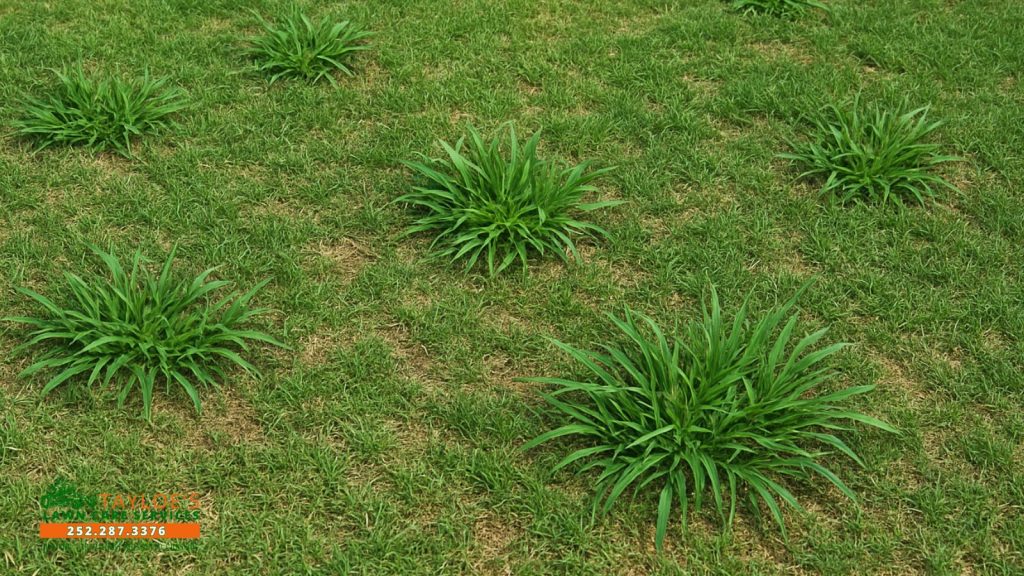
Crabgrass is a low-growing annual weed with broad, spreading blades that form a flat, star-shaped cluster. Unlike turfgrass, crabgrass thrives in hot, compacted, or bare soil. Once it takes hold, it can spread rapidly across thin or stressed areas.
Crabgrass germinates in early spring when soil temperatures reach around 55°F for several days—something that happens earlier in our area than homeowners expect.
The most effective way to get rid of crabgrass: pre-emergent treatment
Crabgrass control starts before you see it, not after. The key to long-term success is stopping seeds from germinating.
Best timing for Eastern NC
- Apply a pre-emergent herbicide in late February
- Apply a second round in May to prevent breakthrough
Soil temperature—not calendar date—is what matters most. Warmer winters can push germination even earlier.
Recommended active ingredients
- Prodiamine
- Dithiopyr
- Pendimethalin
These products create a barrier that prevents crabgrass seedlings from developing.
What to do when crabgrass has already appeared
If crabgrass is already visible, you need a post-emergent treatment. These products selectively target crabgrass without harming turf when applied correctly.
Best treatment options
- Quinclorac (most effective for mature crabgrass)
- Fenoxaprop
- Mesotrione (safe for many turf types, especially fescue)
Be sure to read labels carefully. Some treatments are not safe for centipede grass.
Good timing for post-emergent
- Treat young crabgrass early in the season
- Avoid treating during drought stress
- Avoid treating just before heavy heat waves
Repeated applications may be needed depending on infestation level.
Mowing techniques that help eliminate crabgrass
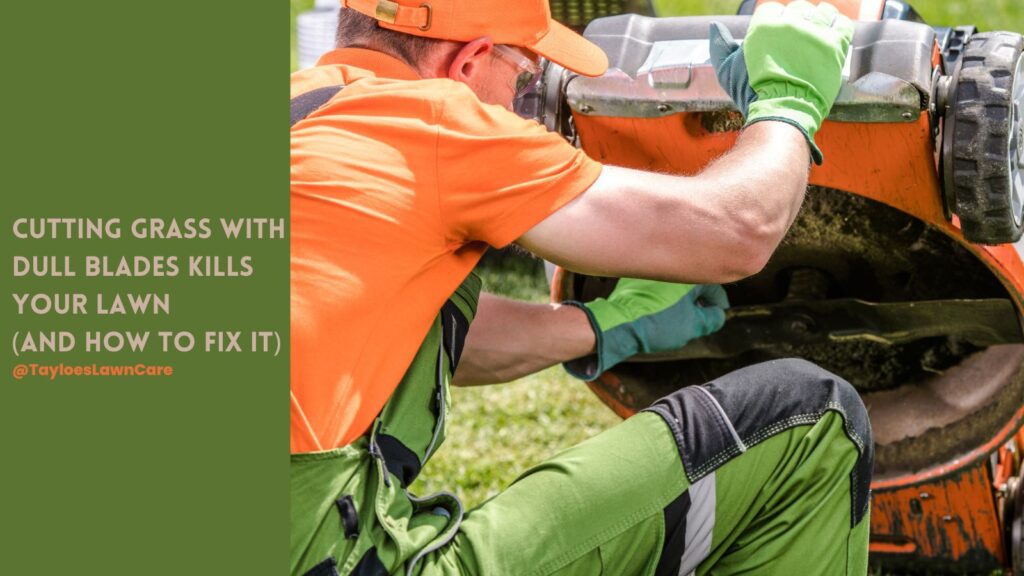
Crabgrass thrives when lawns are mowed too short. Adjusting mowing height gives turf a competitive edge.
Recommended mowing heights to get rid of crabgrass
- Bermuda: 1–2 inches
- Zoysia: 1.5–2.5 inches
- Centipede: 1.5–2 inches
- Tall fescue: 3–3.5 inches
Proper mowing reduces sunlight penetration to crabgrass seedlings and protects turf density.
Improving soil health prevents crabgrass from returning
Crabgrass loves weak turf. Strengthening your lawn makes it harder for weeds to take over.
Ways to improve soil
- Core aerate compacted soil
- Add compost or organic matter when needed
- Maintain proper pH levels
- Avoid excessive nitrogen, especially on centipede
A healthier soil base means thicker turf and fewer weeds.
Watering practices that reduce crabgrass pressure
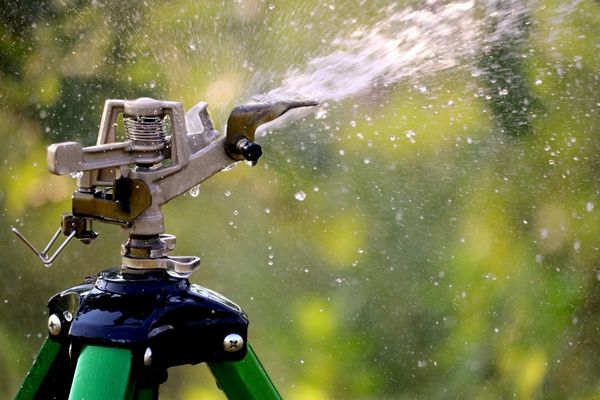
Shallow or inconsistent watering encourages weeds. Deep, occasional watering helps roots grow downward and strengthen turf.
Watering guidance
- Aim for about 1 inch of water per week
- Water deeply, not daily
- Use a tuna can or rain gauge to measure
Deep roots outcompete crabgrass seedlings.
Overseeding helps choke out crabgrass
Thin lawns invite crabgrass. Thick lawns crowd it out.
Overseeding guidelines
- Overseed fescue in early fall
- Overseed Bermuda in late spring only if needed
- Avoid overseeding during heavy summer heat
The thicker the turf, the less space weed seeds have to germinate.
Common homeowner mistakes that make crabgrass worse
Many well-intentioned efforts accidentally strengthen crabgrass.
Avoid:
- Applying pre-emergent too late
- Watering lightly and often
- Mowing too short
- Ignoring thin or bare spots
- Skipping the second pre-emergent round
- Using the wrong herbicide for your turf type
Correct timing and proper care do most of the work.
When to call a professional
If crabgrass has overtaken large areas, or if years of outbreaks have weakened your turf, a professional treatment plan may save time and reduce long-term costs. Severe infestations often require both corrective treatment and soil rehabilitation.

Get rid of crabgrass for a healthier, prettier lawn
The most effective way to get rid of crabgrass in Eastern North Carolina is to apply pre-emergent early, treat visible outbreaks correctly, and strengthen your turf so crabgrass has nowhere to spread. When mowing, watering, and treatment timing align, crabgrass becomes a manageable problem instead of a recurring one.
Related Reading:
Author Profile

- Randy Tayloe is the COO of Tayloe's Lawn Care Service, LLC. He is a certified custom applicator, recognized by the North Carolina Department of Agriculture Pesticide Division. A native of Bertie County, NC, and graduate of Bertie High School, he wants to beautify his home county - one yard at a time.
Latest entries
 Lawn CareOctober 5, 2026Signs of lawn disease in NC
- Lawn CareSeptember 29, 2026Lawn care disasters to avoid (especially in our climate)
- Pest ControlSeptember 22, 2026How long do mosquitoes stay active in NC?
- Pest ControlSeptember 16, 2026Getting rid of armyworms