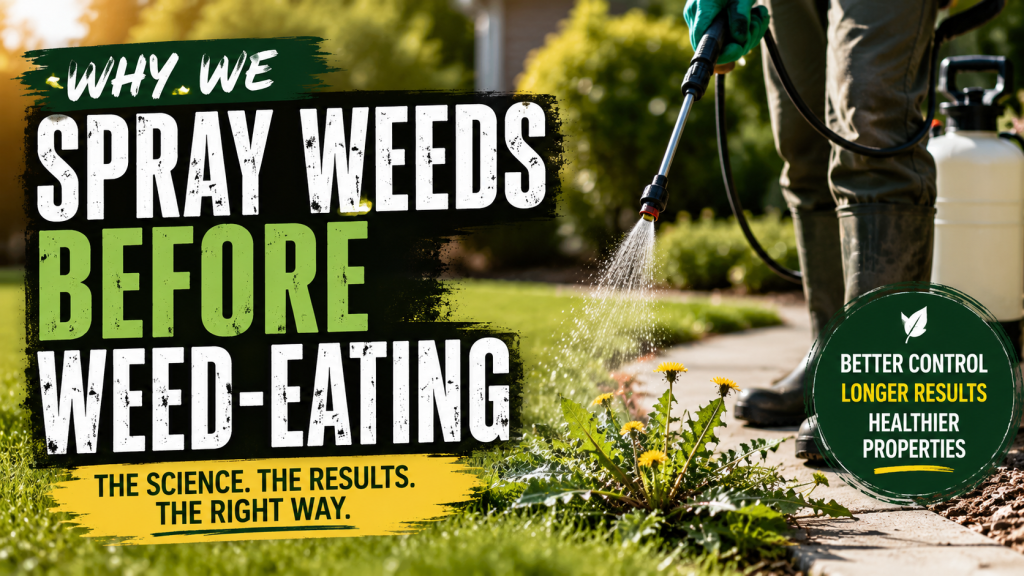
Why do we spray weeds before weed-eating instead of cutting them down first? That’s one of the questions we hear most often from our residential and commercial lawn care customers.
It’s a fair question. At first glance, weed-eating everything before spraying seems like the logical approach. The property immediately looks cleaner, and it feels like spraying the short stems afterward should finish the job.
In reality, doing it in that order can make the herbicide much less effective.
There’s a reason we usually spray first and weed-eat on the next visit. It isn’t about taking shortcuts, skipping work, or leaving the property unfinished. It’s about giving the herbicide enough healthy plant material to do the job properly.
Key Takeaways
- We spray weeds before weed-eating to ensure herbicides effectively contact healthy plant material.
- Herbicides need leaf contact to work; cutting weeds first limits the surface area for absorption.
- Waiting for the herbicide to take effect leads to better long-term control instead of just short-term aesthetics.
- Immediate appearance might look cleaner, but it can result in recurring weed problems later.
- Different conditions and plant types may require adjustments to the standard spraying and weed-eating order.
Herbicides Need Leaf Contact to Work
Most post-emergent herbicides are designed to be absorbed through the green, growing parts of a weed.
That means the leaves, seed heads, and stems all provide valuable surface area for the product to contact. The more healthy leaf surface is available, the greater the opportunity for the herbicide to be absorbed.
With a systemic herbicide, the product enters through the plant’s surface and moves through the weed. It doesn’t simply burn the visible growth. It works its way through the plant, including toward the roots, so the weed is controlled from the inside out.
That process depends on having enough plant material to treat.
When we weed-eat first, most of the leafy surface disappears. Instead of spraying a full weed with broad leaves, a head, and several stems, we may be left spraying one short piece of stem near the ground.
That small stem gives the herbicide far less area to contact.
The product may still affect the weed, but it usually doesn’t have the same opportunity to work as thoroughly as it would on a healthy, actively growing plant.
The basic principle is simple:
The more healthy leaf surface the herbicide reaches, the better chance it has to control the entire weed.
That’s why we spray first, cutting them down on our next visit.
Why We Don’t Cut the Weeds Down Immediately
We understand why customers want the weeds cut down right away.
Freshly trimmed areas look neater. On a commercial property, managers may be concerned about what customers, tenants, or property owners will see. On a residential property, a homeowner may simply be tired of looking at tall weeds along a fence, building, ditch, or other hard-to-maintain area.
Appearance matters. We understand that.
Here’s the reality:
Cutting weeds before treating them may solve the appearance issue for a few days without solving the actual weed problem.
Weed-eating removes the visible top growth, but it doesn’t necessarily kill the plant. In many cases, the roots are still healthy and ready to send up new growth.
If we then spray only the remaining stem, the herbicide has less plant material to work with. The weed may recover, begin growing again, and leave us dealing with the same problem a short time later.
We don’t want to make weeds shorter.
We want to control them.
What to Expect After We Spray Weeds
Another common question is, “You sprayed several days ago. Why are the weeds still standing?”
Because most herbicides don’t work instantly.
Depending on the product, weed species, growing conditions, temperature, and moisture, it can take seven to ten days for the full effect to become visible.
The first signs may be subtle.
You may notice leaves beginning to curl, yellow, wilt, or lose their healthy color. Growth may slow before the weed begins to turn brown. Some plants decline quickly, while others take longer.
A weed that’s still standing isn’t necessarily a weed that’s still healthy.
In many cases, the product is already moving through the plant and doing exactly what it was applied to do.
That’s why we give the herbicide time to work before cutting the treated growth down.
On a later visit, once the weeds have absorbed the product and are dead or clearly dying, we can weed-eat the remaining vegetation if trimming is needed.
At that point, we’re removing dead plant material instead of cutting down a healthy weed before the treatment has had a chance to work.
Looking Clean Today Isn’t Always the Best Long-Term Strategy
This issue comes up frequently on commercial properties.
Property managers want the site to look right. They don’t want tall weeds around signs, curbs, fences, buildings, utility areas, or parking lots. Their concern is reasonable because the property’s appearance reflects on the business.
The trouble starts when immediate appearance becomes more important than effective control.
We could weed-eat everything first and make the property look cleaner that afternoon. But if the treatment doesn’t work as well afterward, the weeds may return quickly.
That creates a cycle.
The weeds grow, someone cuts them, they grow back, and the same area has to be addressed again. The property may look better for a few days, but the underlying problem hasn’t been corrected.
Spraying first may require a little patience. The weeds may remain visible while the product is working.
The tradeoff is better long-term control.
We’d rather use a process that reduces repeat growth than choose a process that only hides the problem temporarily.
The same principle applies to residential properties.
Most homeowners don’t want a yard that looks good for one weekend and then has the same weeds return two weeks later. They want a property that stays neater with fewer recurring problems.
Sometimes the best decision for next month doesn’t produce the prettiest result today.
Are There Times We Do It Differently?
Yes. Lawn care isn’t one-size-fits-all, and every property has its own conditions.
There may be times when vegetation needs to be trimmed first for safety, visibility, access, or another practical reason. A weed may be blocking a sign, growing into a walkway, interfering with equipment, or creating a hazard.
Different weed species may also require different treatment decisions. Weather, active growth, drought stress, and the condition of the property can all affect how we approach the work.
Some areas may have appearance requirements that need to be considered, especially on commercial sites.
Experience means knowing the standard process, but it also means knowing when circumstances call for an adjustment.
We evaluate what we’re treating, where it’s growing, how the area is used, and what result we’re trying to achieve.
The goal is always the same: use the approach that gives the property the best overall outcome.
There’s a Reason Behind the Order
When customers see weeds standing after a spray visit, they may think the job is incomplete.
It isn’t.
The treatment needs time to work.
By spraying the full plant first, we give the herbicide access to the leaves, stems, and other green surfaces it needs for proper absorption. After the weed has had time to respond, we can remove the dead or dying growth.
That order may not always create the fastest cosmetic improvement, but it usually creates the better result.
Our job isn’t just to make a property look better for one afternoon. Our job is to maintain it properly over the course of the season.
That means understanding how plants grow, how treatments work, and when patience produces a better outcome than rushing to make everything look finished.
That’s why Tayloe’s Lawn Care Services normally sprays weeds first and weed-eats later.
There’s a method behind it, and that method helps us provide longer-lasting weed control for our customers.
Related Reading:
Author Profile

- Randy Tayloe is the COO of Tayloe's Lawn Care Service, LLC. He is a certified custom applicator, recognized by the North Carolina Department of Agriculture Pesticide Division. A native of Bertie County, NC, and graduate of Bertie High School, he wants to beautify his home county - one yard at a time.
Latest entries
 Pest ControlSeptember 8, 2026Grub & beetle control in NC (what works vs. what doesn’t
- Lawn CareAugust 18, 2026Fall lawn prep starts in August in NC
- Lawn CareAugust 11, 2026Mowing height mistakes most homeowners make
- Weed ControlJuly 28, 2026Why do we spray weeds before weed-eating?