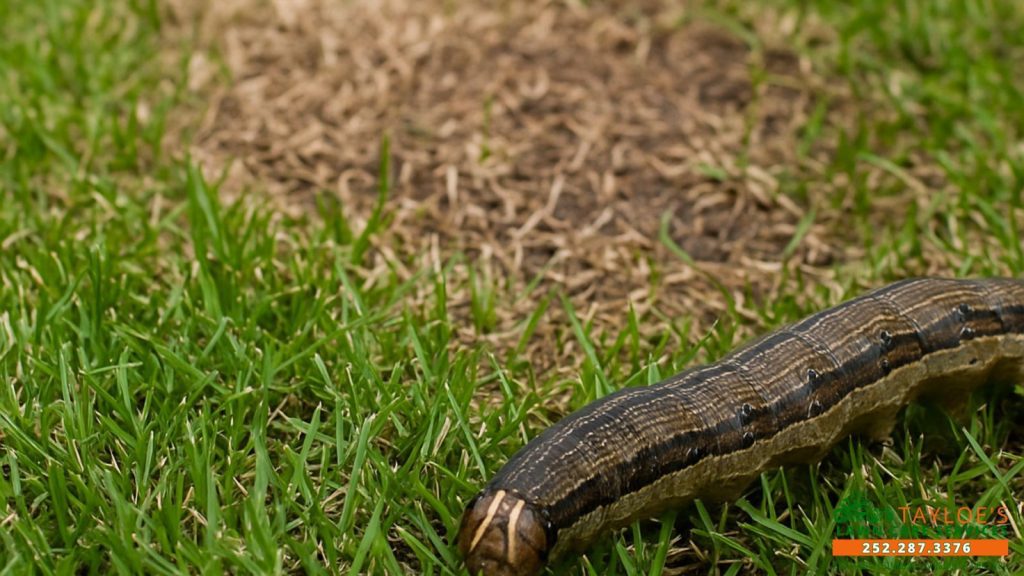
Learn to identify armworms so you can act quickly to eliminate them.
If you’re searching for getting rid of armyworms, chances are you’ve walked outside and found brown patches that seemed to appear overnight—or you’ve seen birds swarming the yard like it’s a buffet. In Bertie and Hertford counties, fall armyworms can strip a lawn in just a few days if they’re not caught early. The good news: with the right identification and treatment strategy, you can stop the damage and help your grass recover.
This guide explains what armyworms are, what they look like, how they damage warm-season lawns, and the best ways to treat and prevent them using evidence-based recommendations from NC State Extension and our own local experience.
What Are Armyworms and Why Are They a Problem Here?
The “armyworm” we’re talking about in lawns is usually the fall armyworm, the larval (caterpillar) stage of a moth that migrates north into North Carolina each year. They love grasses—especially Bermuda and other turf species—and can feed day and night. Source: turf.ces.ncsu.edu
Armyworms are such a concern in Eastern NC because:
- They arrive suddenly, often in mid-to-late summer.
- They can defoliate turf in 24–72 hours when populations are high. Source: Pamlico County Center
- They move in “armies,” marching from one lawn or field to the next once they finish eating.
Researchers at NC State note that fall armyworms often overwinter as pupae further south (like Florida), then moths migrate into North Carolina, laying eggs in waves throughout the season.
For homeowners in Ahoskie, Windsor, Aulander, Colerain, Powellsville, Harrellsville, and Murfreesboro, that means you may see little to no activity one week and heavy damage the next.
What Armyworms Look Like in Your Lawn
When you’re focused on getting rid of armyworms, the first step is being able to identify them correctly.
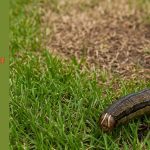
The larvae (caterpillars)
Armyworm caterpillars:
- Grow up to about 1–1.5 inches long.
- Range in color from light green to brown to almost black.
- Have stripes running down the length of the body.
- Show four small black dots on each body segment (on the back) in many individuals.
- Most importantly, have a light-colored inverted “Y” shape on the head—this is a key ID feature.
If you flip them over, they have several pairs of fleshy “prolegs” on the abdomen, like other caterpillars.
Adult moths
Homeowners rarely notice the adult moths, but they’re:
- Tan to gray/brown
- About 1–1½ inches in wingspan
- Marked with a small light spot on each forewing
The moths don’t cause the damage—the caterpillars do. But seeing a lot of moths around outdoor lights mid-summer can be an early warning sign.
How Armyworms Damage Warm-Season Lawns
Armyworms primarily feed on the leaves of your grass, not the crowns or roots—but the feeding can be so intense that the lawn looks dead.
Typical damage patterns:
- Rapid browning that appears in patches or stripes.
- A sharp line between green and brown turf as the “army” moves across the yard.
- Thin, chewed leaves that look “scalped.”
- Damage starts near lighted areas, fences, buildings, or signposts, where moths lay eggs.
Warm-season grasses like Bermuda and zoysia can often recover if the crowns aren’t killed and if the attack doesn’t come late in the season. NC State Extension warns that heavy late-season defoliation can slow recovery the following spring.
How to Confirm You Have Armyworms
You don’t have to guess. NC State Extension recommends a simple soapy water flush to bring armyworms to the surface. Source: nash.ces.ncsu.edu
How to do a soap flush
- Mix 1–2 tablespoons of lemon-scented dish soap into 1–2 gallons of water.
- Stir until suds form.
- Pour the solution over about one square yard of healthy turf next to damaged areas.
- Watch for 5–10 minutes for caterpillars to wiggle up to the surface.
- Repeat in several spots to gauge population levels.
If you see several caterpillars per square foot—especially larger ones (over ¼–½ inch)—you’re dealing with a problem that needs quick attention. Source: Guilford County Center
Getting Rid of Armyworms: Treatment Options
When it comes to getting rid of armyworms, timing and product choice matter.
NC State Extension has produced a Fall Armyworm Management Decision Guide through its TurfFiles program to help turf managers choose appropriate insecticides and timing.
1. Act quickly once you confirm activity
Armyworms can do most of their damage in the last few days of their larval stage, so NC State recommends treating as soon as you detect activity, especially when larvae are small.
2. Insecticide options (big-picture view)
For home lawns, there are two general approaches:
- “Quick knockdown” insecticides – Often pyrethroids like bifenthrin or lambda-cyhalothrin. These kill caterpillars fast but provide only short-term residual protection (about 1–2 weeks).
- Longer-residual products – Active ingredients like chlorantraniliprole (e.g., Acelepryn) can provide extended protection when used at appropriate rates, useful in high-risk periods.
Always:
- Follow the label exactly.
- Choose products labeled for residential lawns or turf.
- Keep children and pets off treated areas until label directions say it’s safe.
If you’re not comfortable choosing or applying products, that’s where a professional lawn care service makes sense.
3. Why granular treatments make sense for homeowners
Liquid sprays work well, but many homeowners prefer granular treatments that:
- Are easier to apply with a spreader.
- Can combine fertilizer plus insect control in a single step.
- Help the lawn recover and resist future stress when properly formulated.
At Tayloe’s Lawn Care, we often use granular blends that pair the right insect control with region-appropriate fertilizer so your grass isn’t just pest-free—it has what it needs to bounce back quickly and thicken up after the damage.
Helping Your Lawn Recover After an Armyworm Attack
Stopping the feeding is only step one in getting rid of armyworms—you also want your lawn to recover well.
Support recovery with:
- Proper watering – Keep soil consistently moist (not soggy) while the grass regrows blades.
- Balanced fertilizer – A light, well-timed feeding (appropriate to your grass type and season) helps it push new growth.
- Avoiding heavy traffic – Don’t run equipment, vehicles, or play heavily on heavily damaged areas while they are thin.
- Overseeding or plugging – In severe cases or late-season damage, you may need to repair bare spots.
NC State notes that warm-season grasses attacked late in the season may not fully recover before dormancy, which is why pairing insect control with good fertility and management is so important. Source: nash.ces.ncsu.edu
Preventing Future Armyworm Outbreaks
You can’t stop moths from flying into your county, but you can make your lawn harder to damage and easier to monitor.
1. Maintain a healthy, dense lawn
Thick turf is your best defense against all pests. That means:
- Regular, appropriate fertilization
- Correct mowing height (not too low)
- Adequate irrigation during summer stress
- Aeration and soil improvement where needed
2. Scout regularly in late summer and early fall
Make a habit of:
- Watching for sudden brown patches.
- Looking for birds actively feeding across your lawn.
- Doing soap flushes if you suspect feeding. Source: nash.ces.ncsu.edu+1
NC State even offers an interactive fall armyworm map so professionals and homeowners can see where activity is being reported across the state, which helps with awareness and timing. Source: turffiles.ncsu.edu
3. Use preventive treatments in high-risk years
In years when armyworms are widespread in North Carolina, a preventive granular insecticide on high-value turf can be a smart investment—especially when paired with the right fertilizer so you’re not making extra passes across the yard.
Frequently Asked Questions About Getting Rid of Armyworms
Will my grass grow back after armyworm damage?
Usually, yes—especially for healthy Bermuda or zoysia lawns, if the crowns weren’t killed and the attack wasn’t extremely late in the season. Fescue lawns are more likely to need overseeding or repair.
Are armyworms dangerous to people or pets?
Armyworms are not dangerous to people or pets; they’re just highly destructive to turf. Still, follow all product safety labels when treating.
Can I just wait it out?
Because armyworms can strip turf rapidly and late-season damage can affect next year’s growth, NC State recommends treating promptly rather than waiting.

The Takeaway: Getting Rid of Armyworms
When it comes to getting rid of armyworms, speed and strategy are everything. Once you know what these pests look like, how fast they can strip a lawn, and how to confirm them with a simple soap flush, you can act quickly with proven treatment options. Using evidence-based guidance from NC State Extension plus a smart program of insect control and proper fertilization gives your grass the best chance to recover and stay strong.
If you suspect armyworms or want a healthier, more pest-resistant lawn built on the right granular fertilizer and insect-control treatments, I’d be glad to help you put a plan together. Call or text Tayloe’s Lawn Care Services, LLC at 252-287-3376, and we’ll take a look at your yard.
Author Profile

- Randy Tayloe is the COO of Tayloe's Lawn Care Service, LLC. He is a certified custom applicator, recognized by the North Carolina Department of Agriculture Pesticide Division. A native of Bertie County, NC, and graduate of Bertie High School, he wants to beautify his home county - one yard at a time.
Latest entries
 Pest ControlSeptember 16, 2026Getting rid of armyworms
- Pest ControlSeptember 8, 2026Grub & beetle control in NC (what works vs. what doesn’t
- Lawn CareAugust 18, 2026Fall lawn prep starts in August in NC
- Lawn CareAugust 11, 2026Mowing height mistakes most homeowners make