Why pre-salting before bad weather is beneficial to commercial properties.
The benefits of de-icing treatments before winter weather are easy to miss in eastern North Carolina, where heavy snowfall is rare. Still, slick conditions can show up fast. At Tayloe’s Lawn Care Services, we help commercial properties prepare for those surprise dustings of snow or thin layers of ice—without full plowing services that simply aren’t necessary most winters here.
When freezing conditions hit overnight or early morning, having a pre-treatment in place can make a noticeable difference in how quickly surfaces clear once temperatures rise.
What de-icing treatments actually do
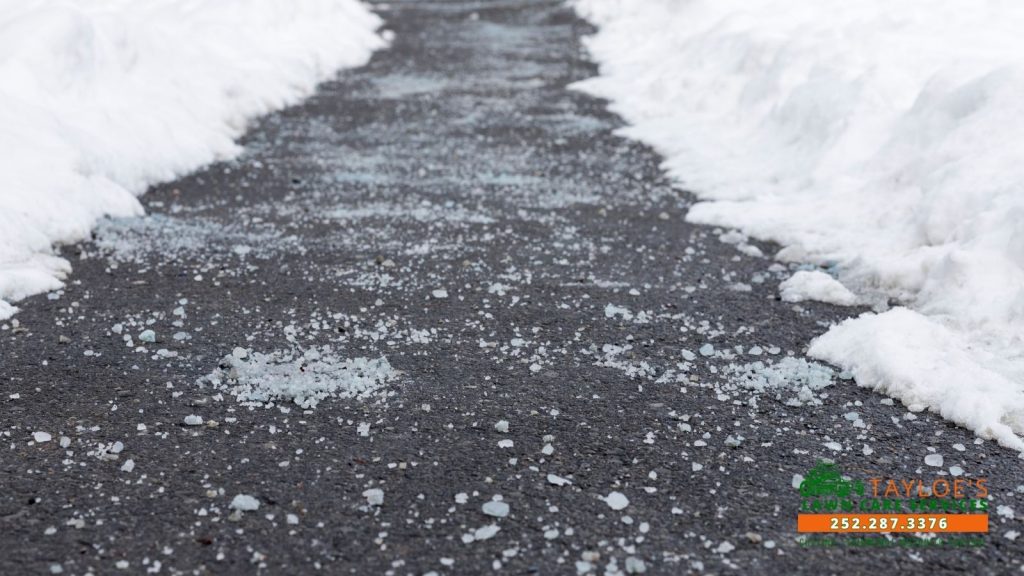
Pre-salting, sometimes called anti-icing, involves applying a de-icing material to paved surfaces before winter weather arrives. The product may not eliminate snow or ice entirely, but it creates a barrier that makes frozen precipitation easier to break down once it forms.
This approach is especially useful in areas like Bertie and Hertford counties, where winter events are usually brief and light rather than long-lasting storms.
Why pre-salting makes sense for our local winters
Eastern North Carolina winters are unpredictable. One night might bring nothing, while the next brings a light glaze of ice or a quick dusting of snow. Full plowing setups are often unnecessary, but doing nothing can leave parking lots and walkways slow to clear.
Pre-salting treatments before winter weather are designed for exactly these conditions:
- Short-duration winter events
- Overnight freezing followed by daytime warming
- Light snow or thin ice rather than deep accumulation
By planning ahead, commercial sites aren’t scrambling once conditions appear.

Supports faster melting when conditions change
One of the main benefits of pre-salting treatments before winter weather is that they support faster melting once temperatures begin to rise. Pre-treated surfaces are less likely to allow ice to bond tightly to the pavement.
This means:
- Ice and snow can break down more quickly as temperatures warm
- Sun exposure becomes more effective
- Follow-up treatments, if needed, can work more efficiently
It’s a practical approach for properties that don’t need constant winter maintenance but still want responsiveness when conditions shift.
Ideal areas for de-icing treatments
De-icing is most effective on high-use, hard surfaces where light ice or snow tends to linger. Commercial properties often focus on:
- Parking lot entrances and drive lanes
- Sidewalks leading to building entrances
- Loading areas and service access points
- High-traffic pedestrian zones
Targeting these areas allows businesses to prepare without over-treating the entire property.

Why we don’t offer full plowing service
At Tayloe’s Lawn Care Services, we tailor winter services to local realities. Because we typically see limited actual snowfall, full plowing equipment and contracts often aren’t a practical fit for most commercial sites in our service area.
Instead, we focus on:
- Monitoring forecasts closely
- Applying pre-salting treatments before winter weather when conditions warrant
- Responding quickly to light snow or ice events
This approach keeps costs reasonable while still addressing the most common winter challenges local businesses face.
Timing de-icing treatments
Pre-salting is most effective when applied ahead of incoming weather, not after surfaces are already frozen. Monitoring forecasts allows us to schedule treatments when conditions suggest a real risk of ice or snow accumulation.
Applying too early or when temperatures are too warm may reduce effectiveness, while waiting too long limits the benefit. This is why communication and planning are key for commercial properties.
Cost factors for commercial pre-salting
The cost of pre-salting treatments before winter weather depends on several factors:
- Size of the paved areas being treated
- Number of priority zones on the property
- Frequency of anticipated winter events
- Access and layout of the site
Because we focus on targeted treatments rather than full plowing, many commercial clients find pre-salting to be a cost-effective winter strategy.
FAQs about pre-salting treatments
Are ahead-of-storm de-icing treatments the same as plowing?
No. Pre-salting is a preventative treatment applied before winter weather, while plowing removes accumulated snow after it falls.
Does pre-salting eliminate all ice?
Pre-salting supports faster breakdown and melting of ice, but results depend on temperature, precipitation type, and duration of the event.
Is de-icing useful with light snow only?
Yes. Light snow and thin ice are exactly the conditions where pre-salting treatments before winter weather are most effective.
How often should a site be pre-salted?
That depends on forecasted conditions and how frequently winter events occur during the season.
Do all commercial properties need this service?
Not always. We recommend pre-salting primarily for sites with regular foot or vehicle traffic during early morning hours.
Related Reading:

How Tayloe’s Lawn Care Services helps commercial sites
We work with commercial clients across Bertie and Hertford counties to prepare for winter conditions without unnecessary services. Our focus is on practical, forecast-driven solutions that match local weather patterns.
If your property doesn’t need full plowing but still needs attention when winter weather threatens, pre-salting treatments may be the right fit.
Contact Tayloe’s Lawn Care Services at 252.287.3376 to discuss winter preparation options for your commercial property and see how we can support faster melting when conditions change.
Author Profile

- Randy Tayloe is the COO of Tayloe's Lawn Care Service, LLC. He is a certified custom applicator, recognized by the North Carolina Department of Agriculture Pesticide Division. A native of Bertie County, NC, and graduate of Bertie High School, he wants to beautify his home county - one yard at a time.
Latest entries
 Lawn CareOctober 5, 2026Signs of lawn disease in NC
- Lawn CareSeptember 29, 2026Lawn care disasters to avoid (especially in our climate)
- Pest ControlSeptember 22, 2026How long do mosquitoes stay active in NC?
- Pest ControlSeptember 16, 2026Getting rid of armyworms